Every few months, the same headline ricochets through gaming Twitter, Reddit, and the group chats: Microsoft bought Steam. It trends. People panic. Valve fans prepare eulogies. XBOX fans start celebrating. And then, like every time before, it turns out to be either a misread headline, a speculative article that got stripped of its question mark during sharing, or someone's uncle who "works in gaming."
So let's put this one to bed with the detail it deserves: did Microsoft buy Steam? What actually happened in the stories that sparked the rumor? And what would it genuinely mean for gaming if it ever did happen?
The Short Answer
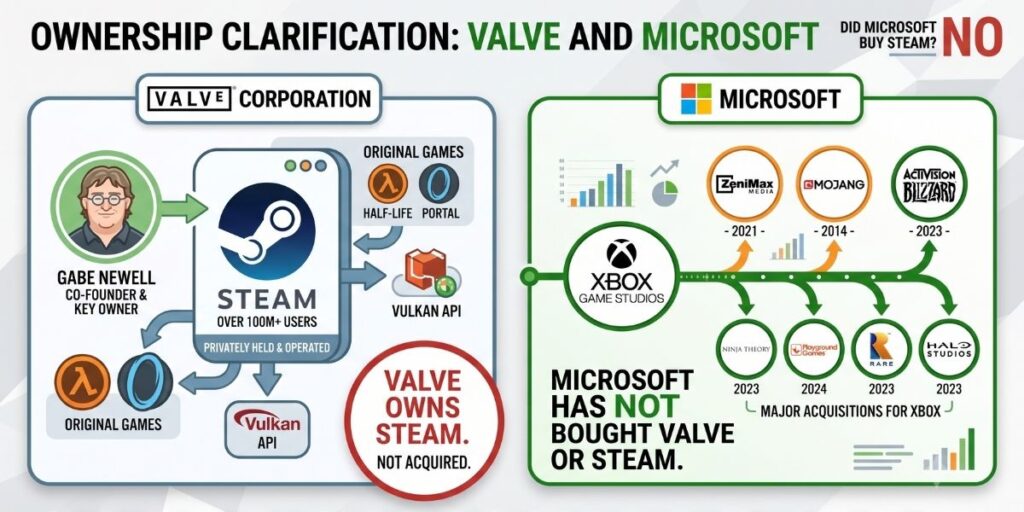
No. Microsoft has not bought Steam. Valve Corporation, the company that owns and operates Steam, remains a privately held company with no public stock and no reported acquisition offers accepted. Gabe Newell is still at the helm. Steam is still independent. As of July 2026, nothing about Valve's ownership has changed.
That's the answer. Everything below is the context that explains why the question keeps getting asked.
Where the Rumor Comes From
The "did Microsoft buy steam" rumor has multiple origin points, and understanding them explains why it's so persistent:
Microsoft's acquisition spree. Between 2020 and 2023, Microsoft acquired Bethesda (ZeniMax Media) for $7.5 billion and Activision Blizzard for $69 billion, making it the largest gaming acquisition in history. When a company spends that kind of money buying studios and publishers, the logical next question from onlookers is "who's next?" and the logical biggest answer is "Valve." The acquisitions created a pattern that made a Steam purchase feel plausible even without evidence.
Valve's private status. Valve is privately held, which means its financials aren't public and its ownership decisions happen behind closed doors. This opacity creates a vacuum that rumors fill. When Microsoft bought Activision, there were months of public regulatory filings, shareholder votes, and press conferences. A Valve acquisition could theoretically happen with far less public warning, which makes the rumor harder to disprove and easier to believe.
Misread and reshared headlines. The usual lifecycle: a gaming outlet publishes an opinion piece titled "Should Microsoft Buy Valve?" or an analyst speculates on a podcast about the theoretical value of a Steam acquisition. The headline gets screenshotted, the question mark gets cropped, and by the time it hits your timeline it reads as a statement. This has happened at least half a dozen times across different media cycles.
The XBOX and PC convergence. Microsoft has been aggressively pushing its games onto PC through the Microsoft Store and Game Pass PC, often with mixed results (the Microsoft Store's reputation among PC gamers is, charitably, poor). Steam is where PC gamers actually buy and play games. The strategic logic of did Microsoft buy steam to solve its PC distribution problem, writes itself, which is why analysts keep floating it and why the rumor feels "inevitable" even though it isn't happening.
Why It Hasn’t Happened (and Probably Won’t)
Gabe Newell doesn't want to sell. Valve is privately owned, profitable beyond most estimates (Steam's revenue from its 30% cut on billions in annual sales is enormous), and run by someone who has shown zero interest in cashing out. Newell has built Valve into a company that operates without publishers, without shareholders, and without the quarterly-earnings pressure that drives most corporate decisions. Selling to Microsoft would end all of that. There's no financial pressure forcing a sale, and no public evidence of interest in one.
Regulatory hurdles would be historic. The Activision Blizzard acquisition faced scrutiny from the FTC, the EU, and the UK's CMA, and that deal didn't involve the dominant PC game distribution platform. Steam holds an estimated 75% of the PC game distribution market. A Microsoft acquisition of that platform would face antitrust challenges that make the Activision deal look straightforward. Regulators in multiple countries would have serious concerns about a console-and-OS manufacturer owning the primary storefront for its competitor's games.
Valve's value makes it impractical. Conservative estimates put Valve's value well above $100 billion when you factor in Steam's market position, the hardware division (Steam Deck), the game catalog (Half-Life, Portal, Counter-Strike, Dota 2), and the sheer recurring revenue of the platform's cut on every sale. Even after the Activision deal, that price tag would be a stretch.
The gaming community would revolt. Steam's reputation is built on being the independent alternative to platform-locked ecosystems. Microsoft buying it would trigger the most significant consumer backlash in gaming history, and Microsoft knows this. The company has spent years trying to rebuild goodwill with PC gamers after the Windows Games for Live era. Buying Steam and risking that goodwill would contradict the entire strategy.
What Would Actually Change If It Happened
Hypothetically, and purely as a thought exercise:
Game Pass would merge with Steam. The most obvious move. Microsoft's entire gaming strategy centers on Game Pass subscriptions. Integrating Game Pass into Steam's library would give it overnight access to Steam's hundreds of millions of active users, which is the distribution advantage Microsoft has been trying to build on its own with limited success.
XBOX exclusives would default to Steam. The Microsoft Store would likely be deprecated for gaming, and Steam would become the default PC storefront for all Microsoft first-party titles. This would actually be popular, which tells you something about the current state of Microsoft's own store.
Third-party publishers would get nervous. Sony, Nintendo, and every publisher that sells games on Steam would face the question of whether they're comfortable with a competitor owning the store shelf. Epic Games Store, GOG, and other alternatives would suddenly have a much stronger pitch to publishers looking for a neutral storefront.
Valve's culture would almost certainly change. Valve is famous for its flat organizational structure, its willingness to cancel projects, and its refusal to operate on traditional schedules (Half-Life 3 being the eternal punchline). Microsoft's corporate structure is the opposite of that. The creative tension between Valve's independence and Microsoft's scale would be the defining story of the acquisition.
The Takeaway
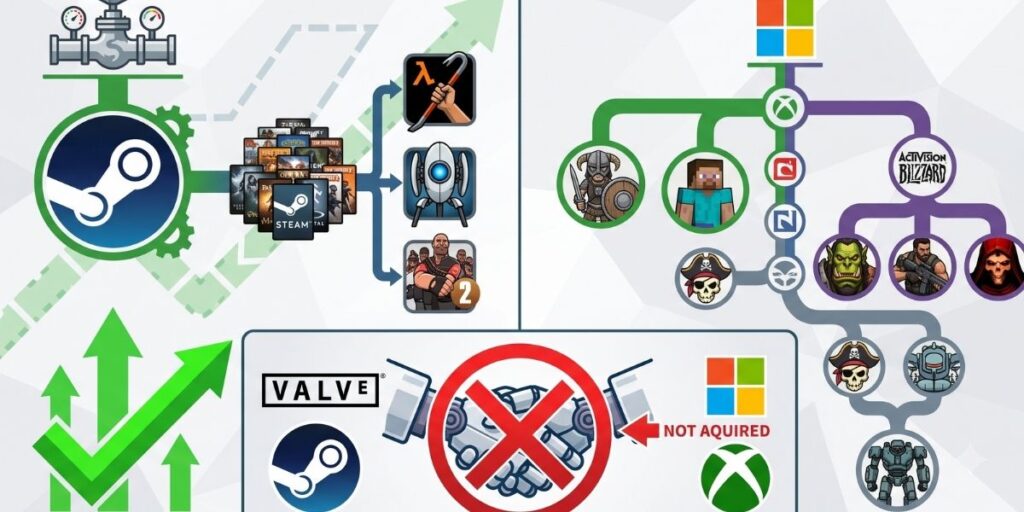
Did Microsoft buy Steam? No. Is it going to? Almost certainly not, for reasons of price, regulation, strategic risk, and the simple fact that the owner doesn't want to sell. The rumor persists because Microsoft's acquisition history makes it feel possible, Valve's privacy makes it hard to disprove, and the internet is very good at removing question marks from headlines.
The next time someone in your group chat drops "did Microsoft buy steam" like it's breaking news, send them this article. Then go back to your Steam library, which is still right where you left it, owned by the same company it's always been owned by, doing exactly what it's always done: taking 30% and never releasing Half-Life 3.

AKA VoltHound. Leads Game Pass coverage, hardware reviews, and cross-platform comparisons. Reviews built on mechanics and value over story (the opposite of Micah, which is why they work). Has uninstalled a game mid-cutscene. Twice. Will do it again.Leads Game Pass coverage, hardware reviews, and cross-platform comparisons. Reviews built on mechanics and value over story (the opposite of Micah, which is why they work). Has uninstalled a game mid-cutscene. Twice. Will do it again. Learn More About Nico