

Every Pokemon has a nature. Most players ignore it. The ones who don't ignore it win more, and the gap between "I just caught whatever" and "I bred for Jolly" is the gap between a Pokemon that hits hard and fast and one that trips over its own stat sheet.
Pokemon natures are one of the oldest hidden mechanics in the franchise, baked in since Ruby and Sapphire, and they quietly shape every competitive battle, every speedrun, and every team build that takes itself seriously. Here's how they work, what each one does, and how to stop leaving damage on the table.
How Pokemon Natures Work
The mechanic is simple once you see it: every nature raises one stat by 10% and lowers another stat by 10%. That's it. A Pokemon with an Adamant nature gets 10% more Attack and 10% less Special Attack. A Pokemon with a Timid nature gets 10% more Speed and 10% less Attack.
Five natures are neutral, meaning they raise and lower the same stat, resulting in no change at all: Hardy, Docile, Serious, Bashful, and Quirky. These are the natures you get when the game doesn't do you any favors, and they're never optimal because you're leaving a free 10% boost on the table.
There are 25 natures total (five stats that can go up times five stats that can go down, including the five neutral ones). The six stats involved are Attack, Defense, Special Attack, Special Defense, and Speed. HP is never affected by natures.
You can see your Pokemon's nature on its summary screen, and in recent games, the boosted stat is highlighted in red and the lowered stat in blue, which saves you from memorizing the full chart.
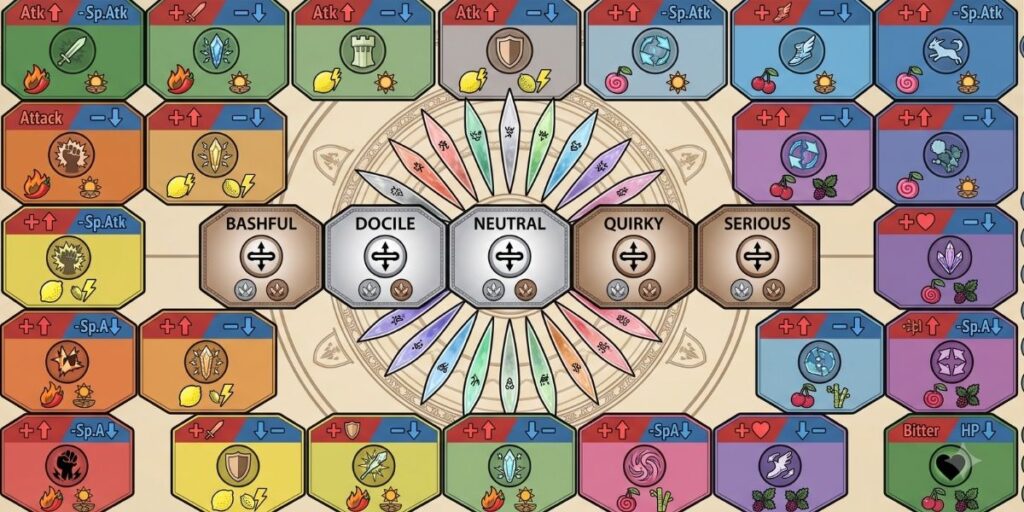
The Complete Pokemon Natures Chart
Attack-boosting natures (for physical attackers):
Lonely: +Attack, -Defense Brave: +Attack, -Speed Adamant: +Attack, -Special Attack Naughty: +Attack, -Special Defense
Defense-boosting natures (for physical walls):
Bold: +Defense, -Attack Relaxed: +Defense, -Speed Impish: +Defense, -Special Attack Lax: +Defense, -Special Defense
Special Attack-boosting natures (for special attackers):
Modest: +Special Attack, -Attack Mild: +Special Attack, -Defense Quiet: +Special Attack, -Speed Rash: +Special Attack, -Special Defense
Special Defense-boosting natures (for special walls):
Calm: +Special Defense, -Attack Gentle: +Special Defense, -Defense Sassy: +Special Defense, -Speed Careful: +Special Defense, -Special Attack
Speed-boosting natures (for fast sweepers):
Timid: +Speed, -Attack Hasty: +Speed, -Defense Jolly: +Speed, -Special Attack Naive: +Speed, -Special Defense
Neutral natures (no stat change):
Hardy, Docile, Serious, Bashful, Quirky: all do nothing. Avoid these.
The Five Natures That Matter Most
In competitive play and serious team building, five natures dominate because they follow one principle: boost the stat you use, lower the stat you don't.
Adamant (+Attack, -Special Attack): The king of physical attackers. If your Pokemon uses physical moves (Close Combat, Earthquake, Iron Head, anything that runs off the Attack stat), Adamant gives you 10% more damage while taking away Special Attack, which you weren't using anyway. No downside. Pure gain.
Modest (+Special Attack, -Attack): The mirror for special attackers. Thunderbolt, Flamethrower, Psychic, any special move hits 10% harder and you lose Attack you didn't need. This is the default for any Pokemon whose moveset is entirely special.
Jolly (+Speed, -Special Attack): For physical attackers who need to outspeed rather than out-damage. The 10% Speed boost often means moving first, which in Pokemon frequently means winning the exchange before the opponent acts. Used on fast physical sweepers where outspeeding a specific threat matters more than raw power.
Timid (+Speed, -Attack): The Jolly equivalent for special attackers. Same logic: 10% more Speed, sacrifice the Attack stat you're not using. Standard on fast special sweepers like Gengar, Alakazam, and most legendary Pokemon running special sets.
Bold (+Defense, -Attack): The wall nature. For Pokemon whose job is to take hits, set up entry hazards, or support the team rather than deal damage. Dropping Attack doesn't matter when your moves are status-based (Stealth Rock, Will-O-Wisp, Toxic), and 10% more physical Defense keeps you on the field longer.

How to Get the Nature You Want
In modern games (Scarlet, Violet, Legends Z-A):
Mints changed everything. Nature Mints (available from competitive shops, Battle Tower rewards, or Tera Raid drops) let you override a Pokemon's nature effects without changing the actual nature label. An Adamant Mint applied to any Pokemon gives it the Adamant stat spread regardless of its original nature. This means you no longer need to breed for natures; you just need to farm or buy the right mint. It's the single biggest quality-of-life improvement competitive Pokemon has ever received.
Breeding with an Everstone: The classic method, still relevant. If a parent Pokemon holds an Everstone while breeding, it passes its nature to the offspring 100% of the time. Combine this with Destiny Knot (passes five of six IVs) and you can breed a perfect-nature, near-perfect-IV Pokemon in a handful of eggs.
Synchronize ability: In games before mints, a Pokemon with the Synchronize ability (Abra, Ralts, Espeon) in the first slot of your party forces wild encounters to match its nature 50% of the time. Useful for catching legendaries with the right nature in older games.
Common Nature Mistakes
Using a neutral nature because you didn't check. A Hardy Garchomp is leaving roughly 15-20 points of Attack on the table compared to an Adamant one at level 100. That's the difference between a knockout and leaving them alive at a sliver. Always check, always correct.
Boosting a stat your Pokemon doesn't use. A Modest Machamp (boosting Special Attack on a physical attacker) is actively worse than neutral. The nature is giving you nothing and costing you something. Match the nature to the moveset, not the other way around.
Dropping Speed when you shouldn't. Brave (+Attack, -Speed) and Quiet (+Special Attack, -Speed) have their uses (Trick Room teams, specifically, where moving last is the advantage), but on any standard team, losing 10% Speed usually means moving second, and moving second in Pokemon means eating a hit you didn't need to take. Default to Adamant/Jolly for physical and Modest/Timid for special unless you have a specific reason to sacrifice Speed.
Ignoring natures in casual play. You don't need perfect natures to beat the main story. The game is balanced for any nature to work in the campaign. But if you're doing Battle Tower, ranked online, or Tera Raids at high difficulty, natures stop being optional and start being the line between clearing and failing.

The Takeaway
Pokemon natures are a free 10% stat boost hiding in every Pokemon you own. The system is simple (boost one stat, lower another, pick the one that matches your moveset), the tools to control it have never been more accessible (mints exist, breeding is streamlined, Synchronize covers the rest), and the difference between the right nature and the wrong one compounds across every battle.
Check the nature. Fix the nature. Then worry about EVs, IVs, and the rest of the optimization stack. Natures are step one, and step one is free.

AKA RogueSignal. PlayStation and Nintendo lead. 130+ platinums, every mainline Zelda finished twice, and a rule he never breaks: don’t publish on a game you haven’t completed. Specializes in narrative-driven games, RPGs, and the kind of completionist runs that make people ask if he’s alright. Learn More About Micah