The Halo Infinite ranks system is simultaneously one of the most rewarding and most frustrating competitive ladders in any current shooter. Get placed well and the grind feels purposeful. Get stuck in a tier that doesn't match your skill and you'll question whether the system, the game, or your life choices are broken. Usually all three, at 1 am, after your fifth loss in a row.
Here's the full breakdown: every Halo Infinite ranks tier, how placement works, what the CSR numbers actually mean, and the practical advice that moves you up rather than sideways.
The Halo Infinite Ranks Tiers, Bottom to Top
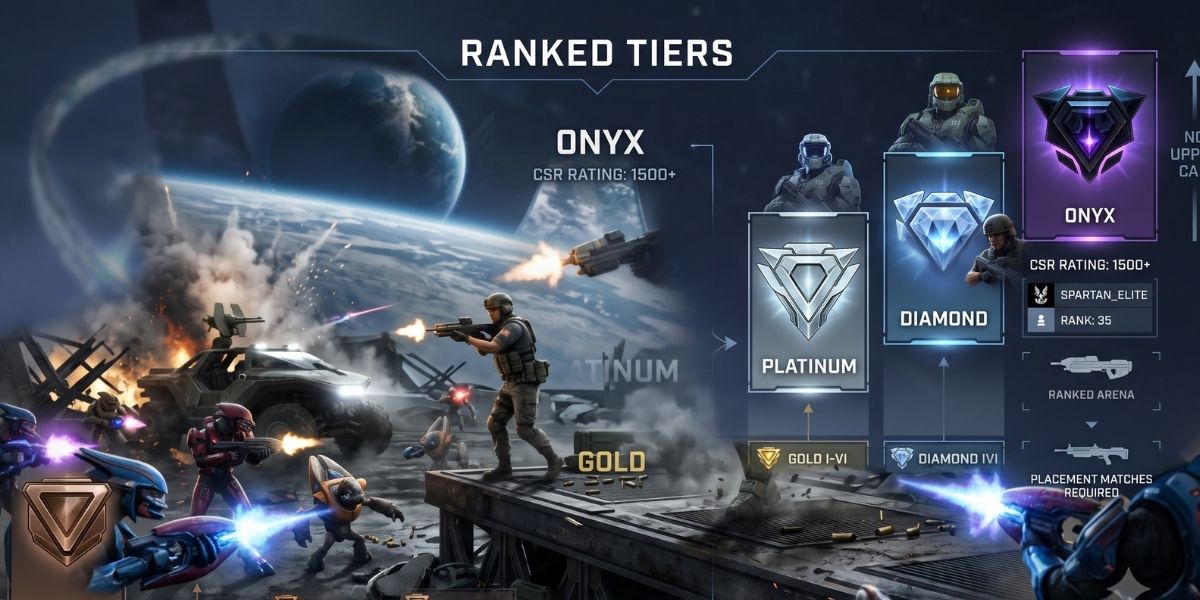
The ranked system uses six tiers, each (except the top) divided into six sub-levels:
Bronze (1-6) The entry point. Players here are learning the fundamentals: weapon spawns, map callouts, and the fact that the AR stops being your best friend against anyone who picks up a BR. Bronze games are chaotic, positioning barely exists as a concept, and climbing out requires basic mechanical competence rather than strategy. If you're here after placement, focus on winning your individual gunfights before worrying about anything else.
Silver (1-6) The first tier where teammates start having intentions, even if those intentions are often wrong. Silver players understand power weapon timers exist but don't always contest them, know callouts for some maps but not others, and can win BR duels inconsistently. The gap between Silver 1 and Silver 6 is larger than most people realize: a Silver 6 is genuinely close to Gold-level play and just needs consistency.
Gold (1-6) The median. Most of the ranked population sits in Gold, which means the skill variation within this tier is enormous. Gold 1 players are Silver with a good day. Gold 6 players are one mental adjustment from Platinum. The defining trait of Gold is that individual skill exists but team coordination doesn't: players can win fights but don't rotate together, don't set up crossfires, and don't trade kills consistently. Climbing out of Gold requires thinking about what your teammates are doing, not just what you're doing.
Platinum (1-6) Where Halo starts feeling like Halo. Platinum players contest power weapons on timer, hold positions with purpose, and punish bad pushes. The BR becomes the primary weapon for most players at this level, and the skill gap between someone who hits four-shots consistently and someone who doesn't becomes the dividing line. Platinum is where most "good" casual players plateau, and breaking into Diamond requires either mechanical improvement (consistent four-shot BR kills, snapshot sniper accuracy) or tactical improvement (knowing when to push, when to rotate, when to bait).
Diamond (1-6) The top 15% roughly. Diamond lobbies are sweaty, coordinated, and punishing. Mistakes that were recoverable in Platinum become deaths in Diamond because opponents capitalize faster. Communication matters here: callouts, combo pushes, and equipment timing (Thruster, Repulsor, Grappleshot) become the vocabulary of every round. Diamond 6 players are knocking on the door of Onyx and typically have either elite mechanics or elite game sense, rarely both, which is why Onyx separates them.
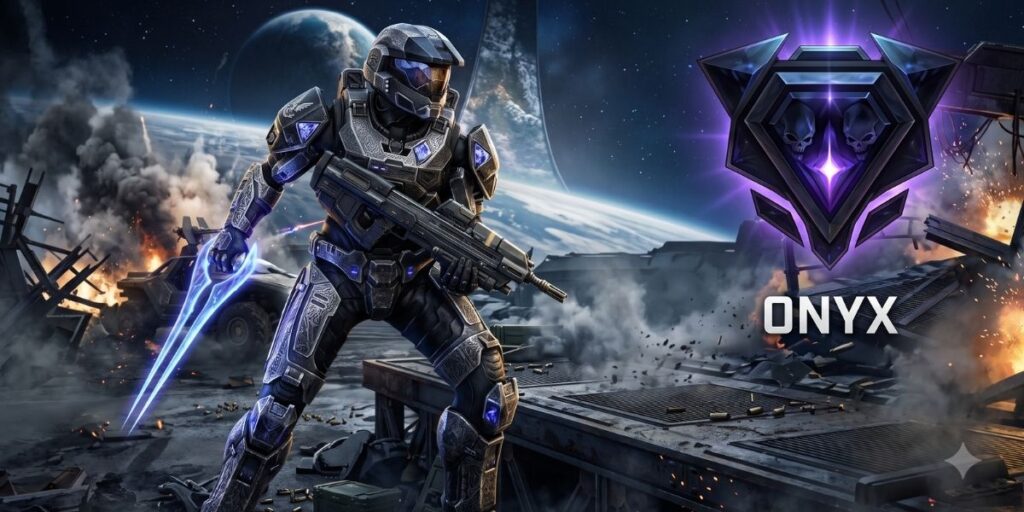
Onyx (1700+) The final tier, and the one without sub-levels. Instead, Onyx uses a visible CSR (Competitive Skill Rating) number starting at 1700 and climbing indefinitely. The leaderboard is open, the competition is professional-adjacent (actual HCS pros play in this pool), and the matchmaking queue times reflect the small population at this level. Reaching Onyx means you are, statistically, one of the best Halo Infinite players in the world. Staying in Onyx means you belong there. The difference matters.

How Halo Infinite Ranks Placement Works
At the start of each season (or when you first enter ranked), you play 10 placement matches. Your initial rank is determined by:
Individual performance, not just wins. The system evaluates your kills, deaths, assists, objective interactions, and damage dealt relative to the lobby's expected performance. This means going 20-5 in a loss can still place you higher than going 8-12 in a win. The system is trying to measure your skill, not your teammates' skill, which is why placement feels more accurate than the subsequent grind for most players.
Your previous season's rank matters. Returning players don't start from zero. The system uses your historical data as a starting point, which means your placements will land near (usually slightly below) where you finished last season. This prevents Diamond players from stomping through Bronze every reset.
Placement can feel wrong. If you went 7-3 in placements and landed lower than expected, the likely explanation is that your per-game stats didn't match the tier the system was testing you against. A 7-3 record with average stats in high-skill lobbies places lower than a 7-3 record with dominant stats in lower-skill lobbies.

How CSR Gains and Losses Work
After placement, every game adjusts your CSR:
Wins gain CSR. Losses lose CSR. The base amount depends on the expected outcome: beating a team ranked higher than yours gains more CSR than beating a team ranked lower. Losing to a lower-ranked team costs more than losing to a higher-ranked team. The system is pushing you toward the rank it thinks you belong at.
Individual performance modifies the amount. A strong performance in a loss still loses CSR but loses less. A weak performance in a win still gains but gains less. This modifier is stronger at lower ranks and weaker at higher ranks, where the system trusts that your rank is accurate and weights wins/losses more heavily.
The system has a hidden confidence rating. The more games you play, the more confident the system is in your rank, and the smaller your CSR adjustments become. This is why the first 20-30 games after placement feel volatile (big swings) and the next 100 feel stable (small movements). If you feel "stuck," it's partially because the system is confident you're where you belong.
How to Actually Climb Halo Infinite Ranks
Bronze to Gold: win your gunfights. At this level, mechanical skill trumps everything. Practice BR four-shots in the Academy firing range, learn to strafe while shooting (the most basic technique that separates low and mid ranks), and focus on not dying rather than getting kills. A 1.2 KD with few deaths is worth more to the system than a 1.5 KD with frequent deaths.
Gold to Platinum: learn the maps. Every map has power weapon spawns on timers, power positions that control sightlines, and rotations that winning teams follow. Watching one tutorial video per map and applying it in-game will move you further than any amount of aim training.
Platinum to Diamond: play with your team. Even in solo queue, mirror your teammates' movements. If two players push a lane, push with them. If your team holds a position, hold it with them rather than flanking alone. Coordinated average players beat uncoordinated skilled players at this tier every time.
Diamond to Onyx: fix the specific thing holding you back. At this level, general advice stops working. You need to identify your specific weakness (positioning after kills, equipment usage timing, sniper accuracy, objective awareness) and grind that one skill deliberately. Review your games if possible. The players who reach Onyx are the ones who stopped blaming matchmaking and started studying their own replays.
The Takeaway
Halo Infinite ranks are built on a system that rewards both wins and individual performance, places you with reasonable accuracy, and then dares you to prove it wrong by climbing higher. The tiers are distinct, the skill gaps between them are real, and the path from Gold to Onyx is paved with specific improvements rather than vague "get better" advice.
The ranked playlist is where Halo lives its best life. Queue up, accept the placement, and start the climb. The leaderboard is waiting.

AKA VoltHound. Leads Game Pass coverage, hardware reviews, and cross-platform comparisons. Reviews built on mechanics and value over story (the opposite of Micah, which is why they work). Has uninstalled a game mid-cutscene. Twice. Will do it again.Leads Game Pass coverage, hardware reviews, and cross-platform comparisons. Reviews built on mechanics and value over story (the opposite of Micah, which is why they work). Has uninstalled a game mid-cutscene. Twice. Will do it again. Learn More About Nico